முருகன்

முருகன்

kili murugan

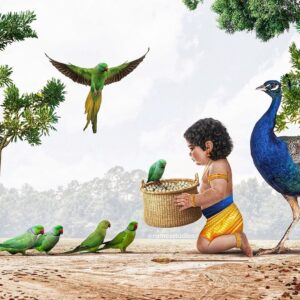
கிளியே  கிளியே  அருகில் வா

கிளர்ச்சி  பொங்க  அருகில் வா

கிளியே கிளியே  நீ பாடு

கிள்ளைத் தமிழில்  நீ பாடு

முருகா குமரா  என்றே நீ

உருகி மருகி   நீ பாடு

கந்தா கடம்பா  என்றே நீ

மந்தாகினி  போல  நீ பாடு

வள்ளி கணவன்  அவன் பெயரை

துள்ளி துள்ளி  நீ பாடு

தெய்வானை மணாளன்  அவன் பெயரை

தாய்ப்பாசம் பொங்கிட நீ பாடு

அன்பே அருளே அவன் வடிவம்

அருளும் பொருளும் அவன் தருவான்

பண்கொண்டு பாமாலை  நீ பாடு

பண்ணார் மொழியில் நீ பாடு

கிளியே கிளியே அருகில் வா

Prof. V. V. Meenakshi Jayakumar


Swami Dakshinamoorthy Life and contribution

திரு. கிரிதரன் அவர்களின் இயக்கத்தில் மலர்ந்த

சுவாமி தட்சிணாமூர்த்தி அவர்களின் வாழ்வும் வாக்கும்

இசை நாடகம் – ஓரு மீள்பார்வை

File:V. Dakshinamoorthy.jpg - Wikimedia Commons

அழகாக திட்டமிட்டு தீட்டப்பட்ட காவியம்

ஆன்மீக அன்பர்களுக்கு இது ஒரு சொல் ஓவியம்

இசை ரசிகர்களுக்கு இனியதொரு வரப்பிரசாதம்

“ஈஸ்வரன் அருள்தான் எல்லாம்“ என்ற உன்னத எண்ணம் கொண்ட

உயர் பெரியவர் சுவாமிகளின்  இசை வாழ்வு ஓர் அற்புத வரலாறு

ஊர் உலகம் அனைத்திலும் இவர் புகழ் பரவ வேண்டும்

எளிய நாடக அரங்க அமைப்பும் ஒரு சாதனை

ஏற்ற இற(ர)க்கம் நிறைந்த வசன உச்சரிப்போ – ஒரு நல்ல போதனை

ஐயமேயில்லை – “வைக்கம் தாதா அன்னதான பிரபோ கோஷம்“  இ(எ)ன்றும்  நம் செவியில்

ஒன்று மட்டும் உறுதி – சுவாமியின் வாழ்க்கை ஒரு சரித்திர இசைப் பயணம்

ஓங்கார நாதம் அவர் மூச்சில் – பேச்சில் – பாட்டில்

ஔடதம் இப்பிறவிக்கு சுவாமி தட்சிணாமூர்த்தி அவர்களின் பாடல் என்பது

ஆன்மீக அன்பர்களின் மெய்யான கூற்று!!!!

முனைவர். வே. வெ. மீனாட்சி

Music Question and Answers

CHECK YOUR MUSIC KNOWLEDGE

  1. Scholar who was the first to codify Ragas into Mela and Janya

Ans:  Ramamatya

  1. The Katapayadi Sankhya is adopted for

Ans: 72 Melakarta Scheme

  1. Purandara Dasa was also called as

Ans: Srinivasa

  1. Place – Music inscribed on rock

Ans: Kudumiyamalai

  1. Modern Thumri developed in

Ans: Avadh

  1. This is not the characteristic of Nada

Ans: Matra

  1. Tagore’s Valmiki-Pratibha is

Ans: Drama

  1. Who was Hemendranath Tagore?

Ans: Rabindranath’s elder brother

  1. Author of Abhinav Bharti

Ans: Abhinav Gupta

10.  The views of Bhatt Nayak on Rasa is called

Ans: Bhuktivad

Important Music books and Authors

AUTHORS AND THEIR BOOKS

AUTHOR                                                BOOK (GRANDHA)

  1. Bharatha                                            Natya Sastra
  2. Illango Adigal                                  Silapathikaram
  3. Mathanga                                          Beihasddessi
  4. Narada                                                Narada Shiksha
  5. Narada                                                Svaranavan
  6. Narada                                                Panchamasura Sambitha
  7. Narada                                                Sangitha makaranda
  8. Datthila                                              Daththilam
  9. Saranga Deva                                   Sangita Ratnakara
  10. Lochanakavi                                     Raga Tarangini
  11. Maharaana Kumbha                     Sangita Raja
  12. Vidyaranya                                        Sangita Saara
  13. Parsvadeva                                        Sangita Samaya Saara
  14. Raja Mansingh Tomar                  Mankuthuhala
  15. Kshemakarana                                 Ragamel
  16. Ramamatya                                       Swaramela kalanidhi
  17. Venkatamahi                                     Chaturdandi prakasika
  18. Somanatha                                         Raga Vibodha
  19. Pundarika Vittala                            Sadraga Chandrodaya
  20. Damodara Misra                              Sangitha Darpana
  21. Govinda Dikshithar                        Sangitha Sudha
  22. Ahobala                                                Sangeetha Parijatha
  23. Tulaja                                                    Sangitha Saramritha
  24. Bhavabhatta                                       Anup Sangita Vilasa
  25. Bhavabhatta                                       Anup Sangita Ratnakara
  26. Govindacharya                                 Sangeetha Choodamani
  27. Abhilashitartha Chintamani      Someshwara
  28. Sangita Sarvarthasara Sangrahamu     —- Ramanujaiaj
  29. Nandikeswara                                    Abhinaya Darpana
  30. Swami Prajnananda                        Historical  Deveopments of Indian Music
  31. Panchamarabhu                               Arivanar
  32. Abhilashitartha Chintamani      Someshwara
  33. B.C.Deva                                               Studies in Indian Music
  34. B.C.Deva                                                Musical Instruments of India
  35. Mrinalini Sarabhai                            Mirror of Gestures
  36. Abhraham Pandithar                       Karunamrutha sagaram
  37. Chinnaswami Mudaliar A.M.       Oriental Music in European Notation
  38. Ravi Shankar                                       My Music, My life
  39. Jayasenapathi                                      Nrittha Ratnavali
  40.  S. Y Krishnaswami                                Musical Instruments of India
  41. Prof.Sambamoorthy                         South Indian Music vols 1 to 6
  42. C.R.Day                                                   Music and Musical instruments of the                                                                              South East Asia and the Deccan
  43. Tansen                                                   Raagmaala, Sangeetha Saara
  44. Subbarama dikshidar                      Sangita Sampradaya Pradarshini
  45. Vemabhoopala                                   Sangeetha Chitamani
  46. Yazh Nool                                            Vipulananda
  47. S.Ramanathan                                    Music in Silapathikaram.
  48. Muthaiah Bhagavathar                  Sangeetha Kalpadrumam
  49. Rangaramanuja Iyyargar             History of South Indian Music
  50. Rangaramanuja Iyyargar             Krithimani malai Vols 1 to 4
  51. Ramakrishna Kavi                           Bharatha Kosa

MUSIC – DARU

Namaste all.

DARU:

  1. Daru is a very special kind of composition and is best suited for musical dramas and dance dramas.
  2. The lyrics of daru describe mythological incidents and historical instances or a love scene or the qualities of patrol.
  3. Daru usually has a Pallavi, Anupallavi and 3 to 5 charanas.
  4. Well composed jathis , and suitable swaras give the right culminaiton.
  5. Daru can be classified mainly according to the type of lyrics it has and the scene it projects.
  6. 1. Pravesha Daru – Paatra Pravesha Daru – This song introduces the actors as they come on the stage. The Actor who does this gets good opportunity to exhibit his talent.
  7. Swagata Daru – This will be in a slow tempo and reveals the mind of the actor and generally welcomes the charators.
  8. Varnana Daru – This details the theme of the Drama and roles played there in.
  9. Samvada Daru – The story moves on in the form of conversation. for this samvada Daru both music and dance are needed.
  10. Kolata Date – This song is accompanied by Kolatta
  11. Uttara – Pratiuttara Daru – Here two charactoers continue the story by means of jokes and witty conversation. This uttara and pratiuttara daru also needs dance and music.
  12. Tillana Daru – It has all the marks of a Tillana and lyrical part includes proverbs and old time themes along with other wordings and lyrics.
  13. Jakkini Daru – The lyrics are in higher speed in this form of Daru-s.  The first part has notes and jathis and the second part has lyrics.
  14. These Darus are popular since three centuries and set to a very rare tala called GuruJhampe having 10 counts.
  15. Oradi Daru – This is known as Madhyama Daru also.  Here, in this Oradi Daru all the charanas portray one single theme and the notation is the same for pallavi and charanas.  Most of the oradi daru describe emphasise patriotism and war.

— to be continued —

Prof.V.Meenakshi Jayakumar


Music – General Knowledge

Namaste all.

1. With which style of singing ‘EK TAAL’ is used?

(A) Dhrupad     (B) Khayal        (C) Thumari      (D) Tappa

Answer: (B)

2. Writer of the book ‘Bhartiya Taalon ka Shashtriya Vivechan’

(A) Dr. Lal Mani Mishra     (B) Dr. Arun Kumar Sen   (C) Acharya K.C.D. Brihaspati       (D) Dr. Avan E. Mistri

Answer: (B)

3. Composition with Tihayee played three times

(A) Tihayee      (B) Tukada       (C) Rela    (D) Chakradar

Answer: (D)

4. The Book in which ‘Theka’ word is used for the first time

(A) Radha Govinda Sangeet Sar        (B) Sarmaye Isharat

(C) Sangeet Naad Vinoda         (D) Sangeet Kaladhar

Answer: (B)

 5. Writer of the book ‘TABLA’

(A) Arvinda Mukherjee       (B) Arvinda Sharma

(C) Arvinda Mulgaonkar     (D) Arvinda Azad

Answer: (C)

6. In which Swar should Tabla be tuned for accompaniment?

(A) Gandhar       (B) Madhyama       (C) Pancham       (D) Shadaj

Answer: (D)

7. Which style of singing is adorned with PARANAS?

(A) Dhrupad       (B) Khayal      (C) Thumari        (D) Tappa

Answer: (A)

8. Which TAAL of Karnatak Taal system is depicted by the symbol of 101?

(A) Dhruva Taal      (B) Roopak Taal      (C) Mathya Taal    (D) Ek Taal

Answer: (C)

9. Most expandable composition of Tabla

(A) Quiada      (B) Tukada      (C) Mohara     (D) Kamali Chakradar

Answer: (A)

10. Match the following:

List – I                        List – II

(i) Zakir Hussain         1. Vazid Hussain
(ii) Kumarlal                2. Kishan Maharaj
(iii) Afak Hussain        3. Allarakha Khan
(iv) Pooran Maharaj    4. Gudai Maharaj

Codes:

(i)         (ii)        (iii)       (iv)

(A)       3          1          2          4

(B)       3          2          1          4

(C)       3          4          1          2

(D)       3          2          4          1

Answer: (C)

— to be continued —

V.Meenakshi Jayakumar

Music – General Knowledge

Namaste all

01. Which of the following musician is famous for Thumri?

(A) Saiduddin      (B) Fahimuddin       (C) Riyazuddin  (D) Bindadeen

Answer: (D)

02. What is the length of ‘Shudha Ni’ according to Ahobal, as per the method of placing the swaras on the 36″ wire of veena?

(A) 20″      (B) 27″       (C) 32″      (D) 18″

Answer: (A)

03. Identify the correct order of tuning the four-string Tanpura:

(A) Madhya Pa, Tar Sa, Tar Sa, Madhya Sa

(B) Mandra Pa, Madhya Sa, Madhya Sa, Mandra Sa

(C) Mandra Pa, Tar Sa, Tar Sa, Mandra Sa

(D) Madhya Pa, Tar Sa, Tar Sa, Mandra Sa

Answer: (B)

04. Ustad Faiyaz Khan was an artist of

(A) Agra Gharana     (B) Gwalior Gharana     (C) Atrauli Gharana   (D) Bhendi Bazar Gharana

Answer: (A)

05 Nandikeshwar is the author of

(A) Raga Tatva Vibodh   (B) Raga Rahasya      (C) Rag Darpan   (D) Abhinaya Darpan

Answer: (D)

06 Jangda Geet is the folk form of

(A) Gujarat     (B) Punjab      (C) Rajasthan     (D) Uttar Pradesh

Answer: (C)

07. Vikrit Swar of Bharat

(A) Teevra Tar Ni    (B) Kaushik Ni     (C) Antar Gandhar   (D) Teevratam Dhaivat

Answer: (C)

08. Dominant chord is formed of

(A) Pa + Ni + Re       (B) Dha + Sa + Ni      (C) Ma + Dha + Sa     (D) Sa + Ga + Pa

Answer: (A)

09. Instrument of equally tempered scale

(A) Tanpura      (B) Violin      (C) Guitar  (D) Harmonium

Answer: (D)

10. What is the basis of classification of Swaras in tempered scale?

(A) Major tone      (B) Minor tone      (C) Semi tone   (D) Half tone

Answer: (D)

— to be continued —

Prof. V. MEENAKSHI JAYAKUMAR
MUSIC – General Knowledge – question and answers

Namaste all.

Music General Knowledge

  1. How many ‘Kakus’ are mentioned in ‘Sangeet Ratnakar’?
    (A) 8

(B) 4

(C) 6

(D) 5

Answer: (C)

2. First person to play Indian Classical Music on Slide Guitar is

(A) Pt. Brij Bhushan Kabra

(B) Pt. Vishva Mohan Bhatt

(C) Pt. Varun Kumar Pal

(D) Nalin Kant Mukherjee

Answer: (A)

  1. Ravanhattha is a folk instrument of

(A) Punjab

(B) Kerala

(C) Madhya Pradesh

(D) Rajasthan

Answer: (D)

4. Correct Bols of Maseetkhani Gat are

(A) Dir Dir Da Dir Da Ra Da Ra

(B) Da Dir Dir Dir Da Dir Da Ra

(C) Dir Da Dir Da Ra Da Da Ra

(D) Dir Da Dir Da Ra Da Ra Da

Answer: (C)

5. Which of the following is a famous dance of Manipur?

(A) Navkuchiya

(B) Teratali

(C) Natuvangam

(D) Laiharoba

Answer: (D)

6. Which of the following is a famous Oddissi dancer?

(A) Sitara Devi

(B) Charan Girdhar

(C) Kumudini Lakhiya

(D) Kelucharan

Answer: (D)

  1. As per Hindustani Music, what is the required interval between ‘Vadi’ and ‘Samvadi’?

(A) 9/12

(B) 10/14

(C) 9/13

(D) 7/11

Answer: (C)

8. Which term was used for orchestra, in Bharat Muni’s Natyashastra?

(A) Vitat

(B) Mandal

(C) Krushtha

(D) Kutap

Answer: (D)

  1. Avirbhav in a raga is meant for which of the following?

(A) Beginning of Raga

(B) Soulful presentation

(C) Reinstatement of Raga

(D) Spiritual presentation

Answer: (C)

10. The conclusive part of ‘Thumri’ is rendered with

(A) Rela

(B) Kayda

(C) Ladi laggi

(D) Jhala

Answer: (C)

— to be continued —

Prof.V.Meenakshi Jayakumar

MUSIC – Sangita Parijatha

Namaste all.

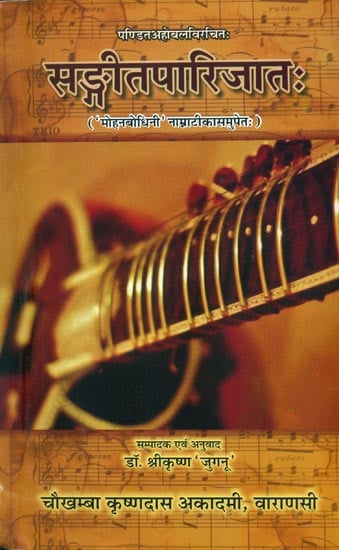
Sangita Parijatha

संगीत पारिजात: Sangeet Parijata


संगीत पारिजात: Sangeet Parijata


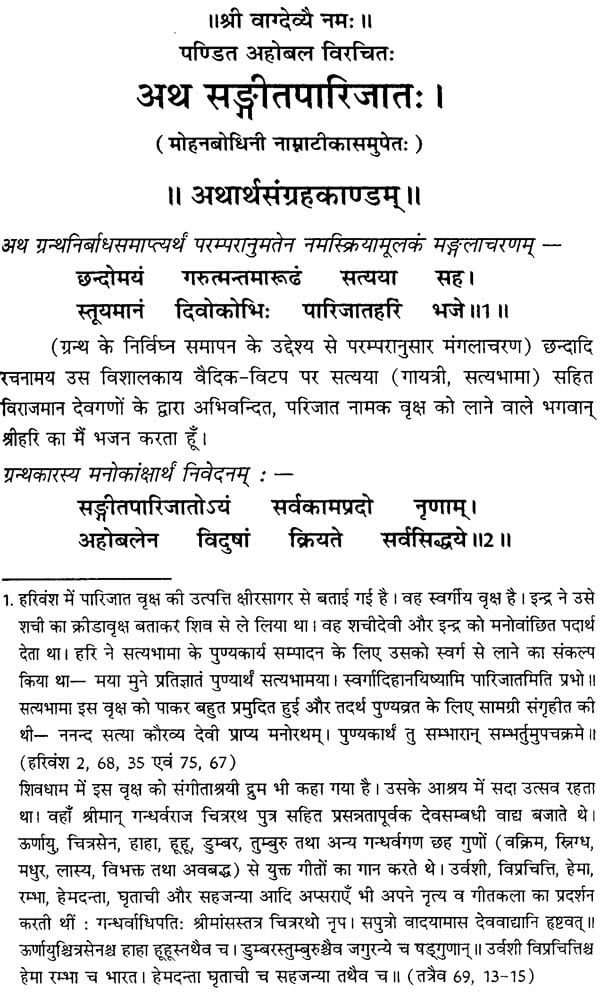
Ahobala’s Sangita Parijatha:

  1. Sangita Parijatha was written by Ahobla who lives in the 17th
  2. He was son of Sri Krishna. (Father’s name)
  3. This work explains how the 22 srutis are arrived at through shadja-panchama bhava. Besides, names for all the 22 sruthis are also given.
  4. He names the 22 sruthis and their positions.
  5. He identified the 12 swaras in terms of the length of the string of the Veena.
  6. The importance of this work is that only this book shows clearly for the first time how we can get different swaras when we pluck a stretched string at different lengths.
  7. 17 kinds of gamakas are illustrated.
  8. It is true that Sangita Parijatha speaks more about Hindustani Music.
  9. The suddha scale described in Sangita Parijatha is the same of todays Kafi Raga.
  10. And that equivalent to the Raga Kharahara Priya of Carnatic music.
  11. Ahobala refers to his music theory with the Principles of Lochana Kavi’s Raga Tarangini (15th Century) and Somanathar’s Raga Vibhodha (1609).
  12. Ahobala describes Mela as a combination of Swaras.
  13. He says it has a power to create the Ragas.
  14. Ahobala describes 122 Ragas in detail with swara structure. He gives the number of their swaras, their time of performance and their characteristic melodic phrases.
  15. Ahobala listed 11340 Ragas. And classified 122 ragas under six mela categories. He even sub divides into Audava, Shadava and sampurna.
  16. According to Ahobala the movement of different swaras in different places that is sthana of the same swara, that various swarasthanas give each Raga an unique flavour.
  17. Ahobala describes 68 types of Alankaras (Vadana-bedha) and is considered as an improvement over Raga Vibhodha of Somanathar.
  18. Ahobala determined the length of the strings of the Veena as the value of swaras.
  19. He names the 22 sruthi and their positions.
  20. He identified the 12 swaras in terms of the length of the string of the Veena.
  21. Ahobalar’s Sangita Parijatha was translated into Persian by Pandit Dinanatha and many other music scholars translated in other Northern languages.

image

— to be continued —

Prof. V.Meenakshi Jayakumar.

General Knowledge on Music- Q&A’s

NAMASTE ALL.

  1. Anudrutam is used in which tala?

(A) Jhampa tala
(B) Rupaka tala
(C) Ata tala
(D) Mattya tala

Answer: (A)

2. Select one itaranama mudrakar:
(A) Syama Sastri
(B) Swati Thirunal
C) Tyagaraja
(D) Ramanad Srinivasa Iyyangar

Answer: (B)

3. Mandari is a janya raga of
(A) 63rd Melakartha
(B) 65th Melakartha
(C) 51st Melakartha
(D) 45th Melakartha

Answer: (C)

4. ‘Kedaram’ is a

(A) Arohana Vakra raga
(B) Avarohana Vakra raga
(C) Ubhaya Vakra raga
(D) Shadava – Shadava ragam

Answer: (A)

5. Bilahari is a
(A) Dvi anyaswara Bhashanga raga
(B) Three anyaswara Bhashanga raga
(C) Ekanyaswara Bhashanga raga
(D) Upanka raga

Answer: (C)

6. Who is the father of the great composer Thiruvottiyur Tyagayyar?
(A) Veena Seshanna
(B) Veena Kuppayyar
(C) Patnam Subramania Iyer
(D) Maha Vydyanatha Iyer

Answer: (B)

7. Who is the composer of Krishnaleela Tharangini?
(A) Narayana Theerthar
(B) Jayadeva
(C) Tyagaraja
(D) Bhadrachalam Ramadas

Answer: (A)

8. Name the chakra of Simhendra Madyamam Raga:
(A) Rishi
(B) Disi
(C) Aditya
(D) Netra

Answer: (B)

9. Who composed ‘Navagraha Kritis?
(A) Muthuswami Dikshitar
(B) Syama Sastri
(C) Tyagaraja
(D) Ambujam krishna

Answer: (A)

 10. Which reputed book was given to Tyagaraja by Saint Narada?
(A) Swararnavam
(B) Naradiya Siksha
(C) Brihaddesi
(D) Ragavibodha

Answer: (A)

—TO BE CONTINUED—

Prof.V Meenakshi Jayakumar.